Hackart
A pose-tracking cart that drives after a person
- Geek CAMP vol.10 hackathon: Effort Award
Overview
A cart that detects a person’s full-body pose with a camera and drives after them. The name is a play on hackathon and cart. It is a motorized conversion of a pedal cart made for three-year-olds, and a person can ride it as well. Over the two-day Geek CAMP hackathon I got it working end to end, from recognition through to drive, and it took the Effort Award, placing among the top three teams.
How I came to enter
In the winter of my second year of high school, a documentary crew from TV Tokyo “THE Meimonko” was scheduled to follow us, and to line up with the filming I entered the online Geek CAMP hackathon vol.10. Most entries are software. Into that field I deliberately brought hardware that physically drives. As the subject I chose a cart that carries luggage and follows its owner, because its usefulness comes across at a glance. Teaming up with the power crew from Mintaka, I went into the two-day sprint.
The cart
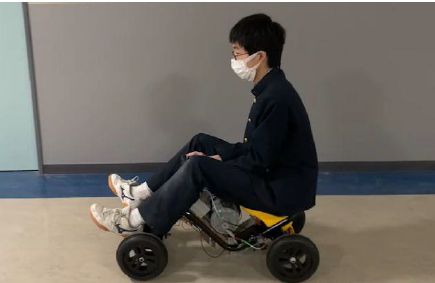 It can also be ridden
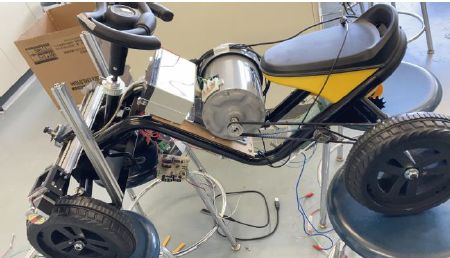
The body was built by reinforcing and modifying a foot-pedal cart made for three-year-olds. Onto that I mounted an industrial three-phase motor, an inverter, and three lead-acid batteries to electrify it. A person can ride it while it drives.
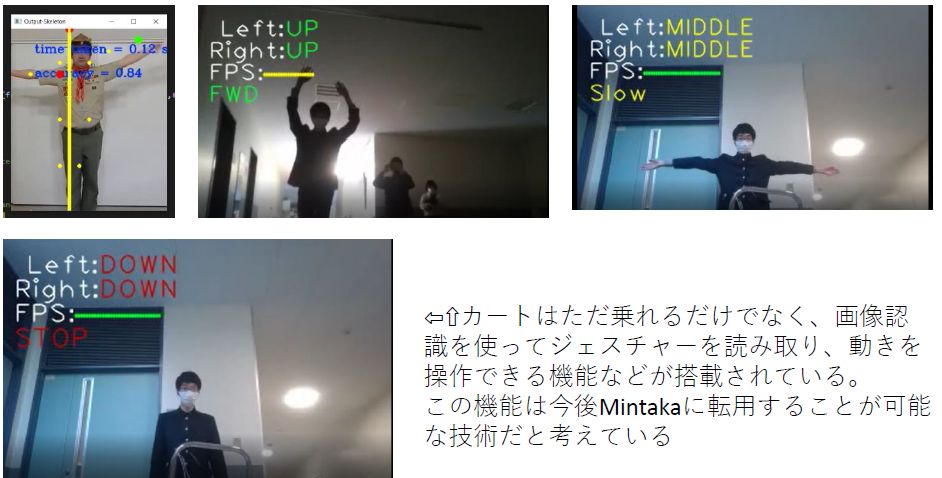 Gesture control via pose estimation: raising and lowering the arms commands forward, slow down, and stop
On top of that I mounted a PC and a camera and built the image recognition pipeline. Python with OpenCV and MediaPipe estimates the person’s full-body pose, steering and speed are decided from where the person appears in the frame, and drive commands are sent to an Arduino over serial. I got it to the point where the cart automatically follows a person based on the detected pose.
Those two days were also the TV filming period. I decided at the outset what to implement thoroughly and what to leave out, gave up on chasing recognition accuracy in favor of running reliably in the live demo, and completed everything, from reinforcing the body to electrification, image recognition, and following behavior, within the two days in front of the cameras.
Results
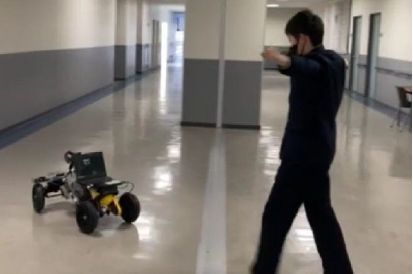 Gesture control demo in a hallway
The result was the Effort Award, placing among the top three teams. More valuable than the award itself, though, was the experience of sprinting to a working state in a short time. It was the polar opposite of the robot competition approach, where a machine matures over several years.